When I was in college, my course load was just shy of full time, but my schedule was intense. I had a part-time job, studied martial arts, played the guitar, and was dating. After a couple of semesters of earning one B for every A, I realized something had to give. As much as I loved the guitar, I stuck it in the back of the closet. And I quit the dojo.

My grades improved. And I learned a hard lesson. Simplifying our lives can require painful sacrifices.
Even with these changes, I was still stretched to my limit. The pressure of having to be creative every day in my studio art classes sometimes became overwhelming. One day I felt like I hit a wall. As hard as I tried to come up with a new drawing for my next lithograph, I couldn’t do it. When I went to my teacher, Charlie Gill, to grumble about my struggle, he did not offer the sympathy I had sought. Instead, he stared at me in disbelief.
“What are you talking about? Subject matter is everywhere!” he exclaimed. “Look around!”
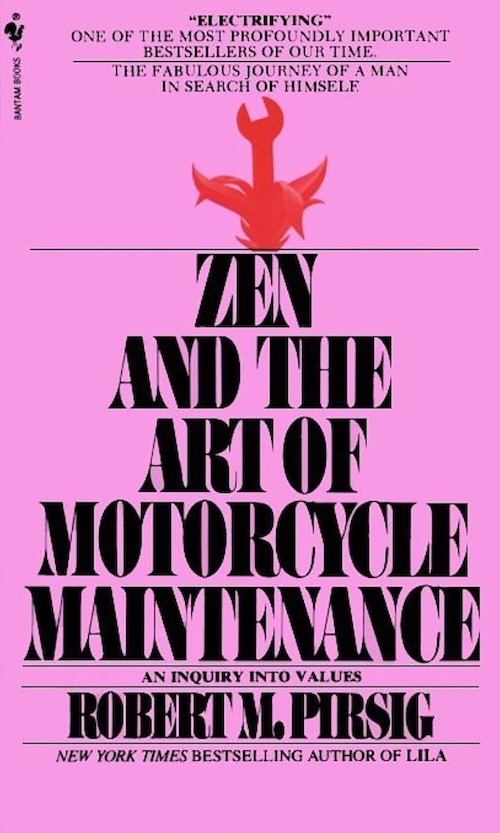
His frustration got me thinking about a passage in Zen in the Art of Motorcycle Maintenance by Robert Pirsig. A teacher gets a sinking feeling, when his student tells him that she plans to write a 500-word essay about the United States. He counsels her to write about Bozeman instead.
On the day the paper is due, the student arrives at class empty-handed. She could think of nothing to say. This time the teacher suggests that she write about one street in Bozeman.
Before the next class, the student came to the teacher in tears. She was still unable to write anything.
He was furious. “You’re not looking!’ he said.” Angrily, he added, “Narrow it down to the front of one building on the main street of Bozeman. The Opera House. Start with the upper left-hand brick.”
That did the trick. The young woman found her voice.
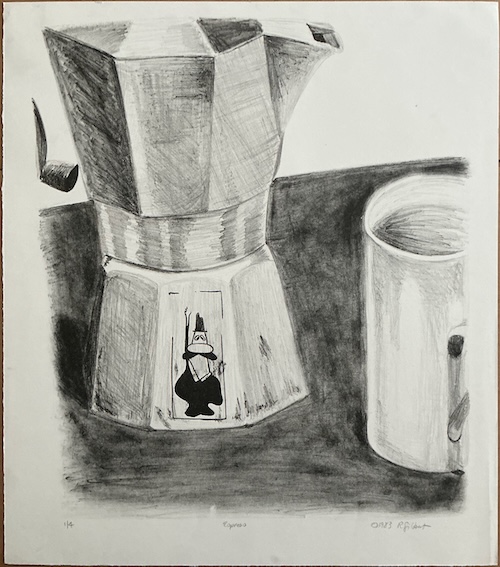
Maybe I couldn’t find a subject to draw because I was overwhelmed by my choices. I thought about that upper left-hand brick in the facade of the Opera House in Bozeman, as I drank my coffee and glanced around my kitchen. The Bialetti espresso pot that I had just used was still sitting on the stove.
My drive for “substance” was more of an obstacle than an aid. After all, not everything I created needed to make a statement or be a masterpiece.
An artist getting stuck like that is equivalent to an author having writer’s block. That never plagues me, when I am writing a book. However, now that I am focused on getting my manuscript published, I am between projects. Even so, if only for my own peace of mind, I need to write. The inspiration for an essay usually comes to me randomly.
If a week or two passes, and I haven’t posted anything new to art2u.com or roxanegilbert.com, I don’t worry about it. But the art history research I’ve been doing lately has become more of a distraction than an incentive to write, and it’s beginning to feel like a problem.
Yesterday, as soon as I got up, I was thinking about “truth.” It’s a huge topic, and one that is frequently on my mind. It occurred to me to write about it, but there is too much to say. The part of me that yearns for simplicity is resistant to tackle an issue that should not be controversial. Yet we live in an era when stating the obvious is often construed as being divisive.
If you could escape the turmoil that swirls around us, where would you go? I saw a picture of a quaint riverside village in northern England, and I longed to be there.
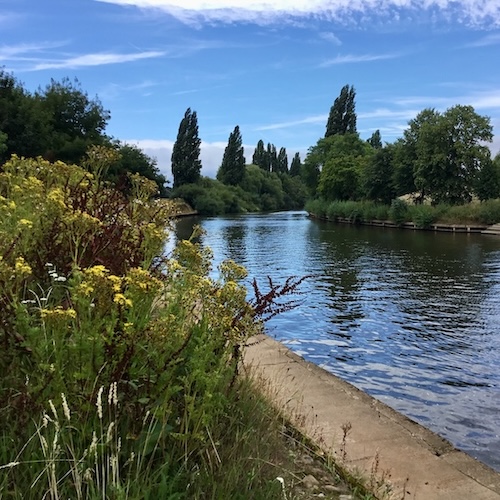
But the idyllic community depicted in the photograph exists only as the reflection of a captured moment. The UK has undergone a seismic shift in recent years. After experiencing an explosive aspect of the changes firsthand during my last visit to London, I wouldn’t assume that a remote hamlet had dodged the shrapnel.
Rather than fantasize about going for a serene stroll in that heavenly countryside, I might do as well to imagine traveling back in time to the England that existed 200 years ago. Beautiful. Confident. Proud.

Discover more from Roxane Gilbert
Subscribe to get the latest posts sent to your email.
 Roxane Gilbert