When I am working on a novel, I have no time for recreational reading. Since I write historical fiction, I burn up many hours poring through source materials: newspaper archives, biographies, letters, memoirs, military records, insurance policies, genealogy charts, maps, history books, etc. My mornings and afternoons are consumed doing research and crafting prose, and most nights are spent editing the words I put on paper earlier that same day.
The first book I read for pleasure after I finished most of the editing on A Moon Garden was The Count of Monte Cristo by Alexandre Dumas père (1802-1870). I loaded it on my Kindle so I would have something to read, in case I couldn’t fall asleep on the red-eye flight from San Francisco to London. Dumas captured my attention and kept it.
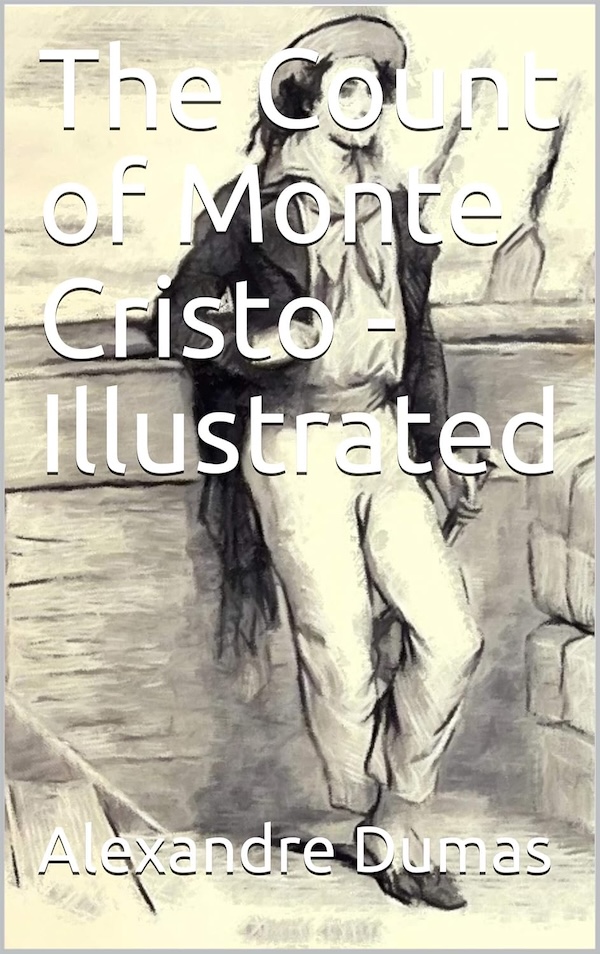
Alexandre Dumas père was born on July 24, 1802, in Villers-Cotterêts, France. He died on December 5, 1870, at the home of his son, Alexandre Dumas fils (1824-1895), in a coastal village near Dieppe. I discuss those final days and the enduring legacy of the extraordinary author in Life and Legacy, a recent article I wrote for this blog.

At the time of Dumas père’s passing, Dumas fils was enjoying the fruits of a successful career as a novelist and playwright. Critical success had come early to him. In 1848, when he was 24-years-old, his first novel was published. La Dame aux Camilles was a fictionalized autobiographical account of the author’s love affair with a courtesan named Marie Duplessis (1824-1847). The young lovers were both 23-years old when they met. Tragically, Miss Duplessis had consumption, and she died a few months later.
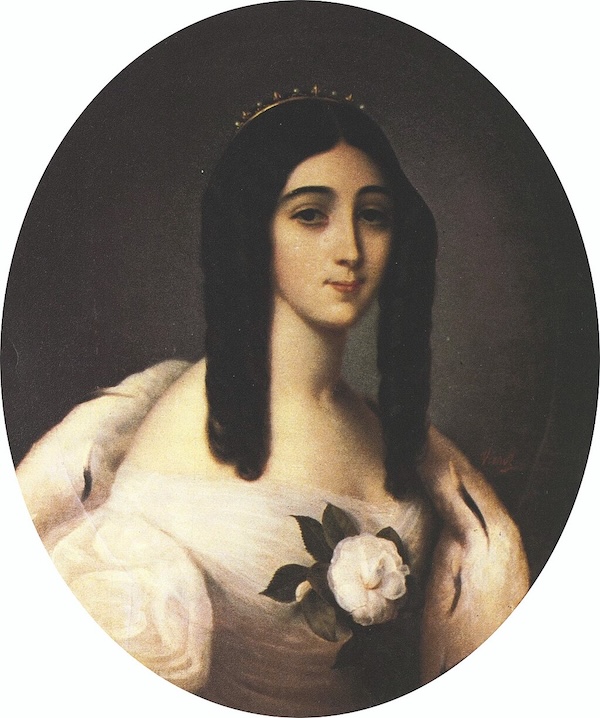
Dumas fils adapted his book into a play. In February 1852, it premiered at the Théâtre du Vaudeville in Paris. After Giuseppe Verdi saw it, he immediately began setting it to music, resulting in his unforgettable opera La Traviata, which premiered the following year.
In the article Memories and Montmartre, I talked about going to Paris a few years ago and visiting the grave of Dumas fils in the Cimetière de Montmartre.
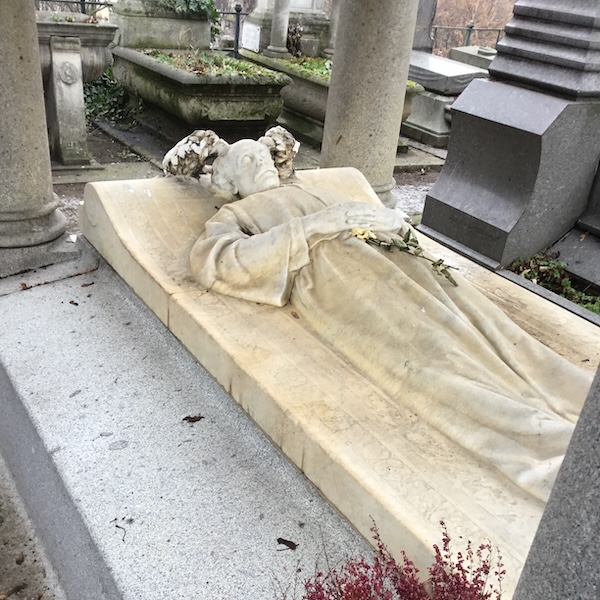
By coincidence, I went to the cemetery only a couple of days after seeing La Traviata at the Royal Opera in London.

These memories came bubbling up once again, as I was writing Seeing and Telling, an article about French artist Théobald Chartran (1849-1907), for my new blog, Art*Connections. He was already a successful portrait painter, when he began drawing caricatures for Vanity Fair.
Chartran’s depiction of Giuseppe Verdi graced the cover of Vanity Fair on February 15, 1879. The December 27, 1879, issue featured Chartran’s caricature of Alexandre Dumas fils.


After a brief stay in Paris, I took the train back to London. My return flight to San Francisco departed from Heathrow at 11:30 a.m. GMT on a Sunday morning. By the time we touched down at 3:00 p.m. PST, I had come to the last of 1,000+ pages of The Count of Monte Cristo. Within a matter of a few exciting days, I had experienced firsthand the legacy of the genius of Dumas père and Dumas fils.
Something else happened on this trip that eventually connected back to Alexandre Dumas père. As I gazed at a portrait of an 18th century British Army officer in a stateroom at Buckingham Palace, I knew that I had to write his biography. Two years later, frustrated with my efforts, I put the manuscript aside.
I had been so intently working, that I had no time for much of anything else. If I was going to take a break, then I was going to kick off my shoes, prop myself up in a comfortable chair, and enjoy a great book. Thinking back to how much I had enjoyed The Count of Monte Cristo, I decided to take on Dumas’s epic, The Three Musketeers.

Maybe I was a little late to the game, but it wasn’t until I read the narrative describing the fate of the Duke of Buckingham that I understood that Dumas père’s masterpiece was not simply a historical adventure anchored to some major players in France and England from the 1600’s. It was actually a dramatization of history. My own research had been the key that unlocked it for me. In my pursuits, I had come to know some of the heirs of the noblemen Dumas had written about. The descendants of these powerful families continued to wield influence more than 100 years later, in the Court of King George III.
That was the moment that I abandoned nonfiction as the vehicle for my next book. Instead, I chose to weave the factual details of a man’s life into a work of historical fiction.
I am forever grateful to that long-forgotten soldier, who motivated me to be relentless in pursuing truth. And I am indebted to Alexandre Dumas père for inspiring me to illuminate that truth with the boldest brightest light I can shine.

Discover more from Roxane Gilbert
Subscribe to get the latest posts sent to your email.
 Roxane Gilbert