“Turn right on Highway 20, and go about a half mile. When you come to the Taco Bell, take a left.”
My co-worker may as well have given me directions to Mars. What was she talking about? Taco Bell? Did our town have a Taco Bell? Although I had lived here for a couple of years, I hadn’t noticed. Fast food joints simply don’t show up on my radar as landmarks.
The good news is that my sense of direction is usually decent. Back in the days before GPS, I would sit down with a road atlas to plan my route. Sometimes I had to pull over to review a map, but I always managed to get where I was going. Late one night in the early 1990’s, during a road trip from California to Oregon, my internal compass was harshly tested.
My friend David had moved to a rural area not far from Portland. Once he was settled, he invited me to come up to assist him in his print studio. At his request, I stopped along the way at a gallery in Davis, California, to pick up some of his ceramic sculptures and several of his large acrylic assemblages.

When I got to the gallery, the owner had all of the artwork encased in bubblewrap, ready to ship. He carried everything to my truck and tied down the load. After about an hour, I was once again on my way.
It became apparent very quickly that the sculpture was not well secured. Even with the noise of the wind and traffic, I could hear things shifting around. To the dismay of the drivers speeding by, I slowed down to about 45 mph. At the next exit, I got off the freeway, drove a short distance, and found a parking spot in a strip mall.
The temperature in the valley that day was over 100℉, and my truck wasn’t air-conditioned. Between the heat and the concern for my precious cargo, I had developed a pounding headache. In the hopes that hydration and caffeine might help, I got a large iced tea at the first McDonald’s that I saw, as I headed north.
For the rest of the ride, I kept my speed at 55 mph, so it was late by the time I turned off the main highway at Salem. I still had about 25 miles to go. By then, I had a full-blown migraine. When I came to an unexpected fork in the road, I clenched my teeth and trusted my innate sense of direction to get me to my destination. Somehow, by the grace of God, it did.
Things went a little haywire for me, when I went to London. For my first two solo ventures, I didn’t have a cellphone, so I had to rely on guidebooks and maps to get around. In the evenings, I would plan for the next day by drawing diagrams and arrows alongside street names in a small notepad. This methodology was far from foolproof, and my failure rate was exacerbated by an inability to control my impulse to go astray. Almost every glance down every side street revealed a new temptation. Inevitably, I would diverge from my path and start exploring.
Unlike the planned, uniform, grid layouts of cities like Manhattan or Chicago, London’s development was more organic. Some roads mimicked the curve of the River Thames and others followed the remnants of medieval footpaths. The irregularity made it extra-challenging to get back on track. Fortunately, a lot of the major intersections had kiosks with maps, so eventually I would figure out where I was.
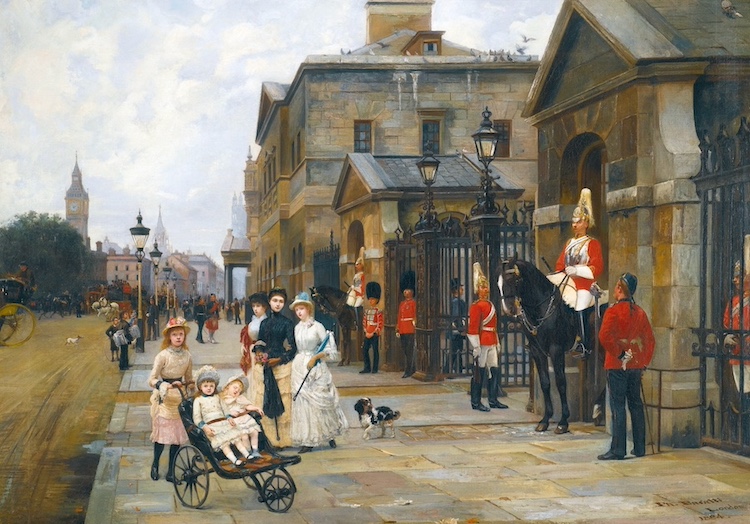
One day, I was walking through Covent Garden on my way to Westminster. Something caught my interest, and I found myself wandering through some quiet, narrow streets. When I was finally disposed to continue on to the Horse Guards, I had no idea how to get there.

There may not be any Taco Bells in London’s West End, but you don’t have to walk far to find a Caffè Nero. As I tried to get my bearings, I saw one of these cut-and-paste, late-20th-century restaurants. It was out-of-sync with the classic architecture of the district and provided no clue as to where I was. Stymied, I paused when I reached a corner where three roads converged. The street signs, mounted high up on the sides of buildings, meant nothing to me. I was far away from a major thoroughfare, and there was no map kiosk in sight. Now what?
There wasn’t anyone about, so I lowered my head a bit and took three deep breaths. As I tamped down my anxiety, I tuned my awareness to the silence beneath the background din. I resolved that, when I looked up, I would ignore the distraction of the modern shops and concentrate instead on the 18th century buildings. As I raised my eyes, the stately Georgian architecture came into sharp focus, and I instantly knew how to proceed. Fifteen minutes later, I was standing on the corner of Whitehall and Horse Guards Avenue.

I went to London three times between January 2019 and the Covid lockdowns in March 2020, to do research for a historical novel. The city energized me. As soon as all the pandemic travel restrictions were lifted in 2022, I went to England to complete my research and to work on my manuscript.
Subtle changes are easy to overlook, when you visit a place every six months. With a gap of more than two years between visits, however, the differences were more obvious. The encroaching graffiti was apparent in 2019, but it just made me scratch my head and wonder why the tolerant Brits were putting up with it. By the summer of 2020, it wasn’t just a little graffiti. True, it didn’t rise to the level of defacement that had sullied Manhattan by the mid-1970’s, but no one in the UK seemed interested in cleaning it up or enforcing anti-vandalism laws.
I lived in New York when the graffiti first appeared in the subways. On the West Side of Manhattan, a tagger scrawled his handle “Taki 183” on the wall of every station and train car. Soon there were imitators. Then the pissing match began, to see who could spray his tag in the biggest, boldest letters. It wasn’t long before nearly every square inch of the subway system had been marked by some attention-seeking thug. The visual blight had also popped up all over the streets.
This kind of problem doesn’t fix itself. Many New Yorkers had bleakly resigned themselves to the rampant mischief. However, in the mid-1990’s, they elected a principled, visionary mayor, who proved that there was a way out of the darkness.

It wasn’t just graffiti that was starting to spread in London. When I was there in 2019, I was pleasantly surprised that there was not an obvious homeless problem. The same could not be said for Los Angeles, San Francisco, or Paris. By that year, all three of these great cities were littered with debris-strewn tent encampments.
By 2022, however, rough sleeping in London was commonplace. Just outside my hotel in Fitzrovia, homeless people had staked out little pieces of public turf, where they lingered for much of the day and night. Some of them were in obvious need of medical attention or addiction counseling.
Despite the unpleasant symptoms of the city’s deterioration, I still loved London and had every intention to go back. Personal business kept me home for several months. Then on October 7, 2023, thousands of Gazans poured into Israel to rape, torture, kidnap, and slaughter hundreds of civilians. Immediately afterward, the streets of Westminster became a site where angry protestors gathered weekly in solidarity with the perpetrators of the barbaric massacre.
“Globalize the Intifada” is a particularly abhorrent chant, when you consider that during the Second Intifada (Sep 2000-Feb 2005), over 1,000 people in Israel lost their lives in terrorist attacks. Yet I understand that those grotesque words may be protected speech in freedom-loving America and the United Kingdom. However, when you compare the way UK officials ignore persistent calls for death to Jews but don’t hesitate to prosecute British citizens for posting “hurty words” on Facebook or to put handcuffs on Christians for praying in the public square, it’s chilling.
As much as I long to stroll through St. James’s Park, or gaze across the River Thames from Victoria Tower Gardens, or meander through the National Gallery, or dine in a 17th-century pub, I am not inclined to return to a city where I must constantly look over my shoulder or avert my eyes. Britain’s 1,500-year history is full of intrigues, betrayals, enlightenment, and glory. It is still a nation of good, strong people. A day will come when the UK regains its equilibrium. Perhaps once again I may have that comforting feeling that, when I am in England, my heart has found its home.
Discover more from Roxane Gilbert
Subscribe to get the latest posts sent to your email.
 Roxane Gilbert
Thank you always for enlightening glimpses into our fascinating cultures and their inhabitants!
Thank you for your kind words.