The temperature was forecast to rise to 104℉. I can tolerate heat better than my dog, but I have my limits too. We set out for our walk earlier than usual, while the sun was low on the horizon, and a Delta breeze was still having its cooling effect in the valley.
A patch of the neighbor’s lawn held a great deal of interest for my little companion. When he finished sniffing it, we continued on our way. Just a few feet ahead, I noticed a fascinating pattern on the sidewalk. Sunlight hitting an oversized chrome rim of a truck tire had bounced back onto the concrete pavement, creating an image that reminded me of a mandala.
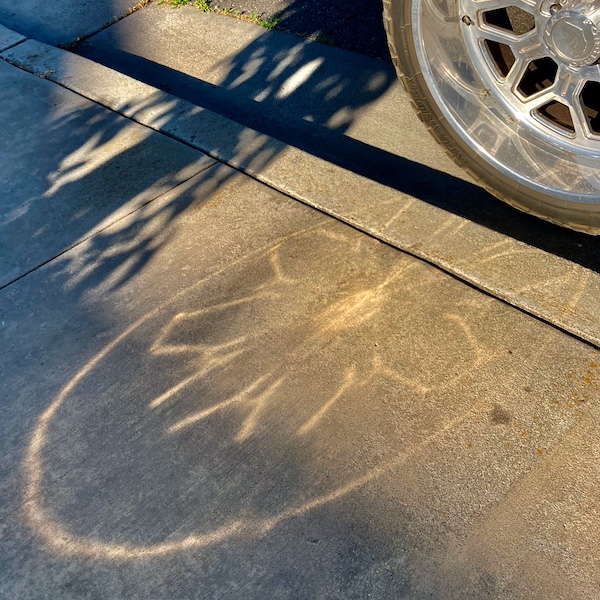
When we returned home from the park, I was still thinking about the unusual reflection I had seen. It got me reminiscing about my first painting teacher.
The smell of turpentine that permeated the air of the foyer at the Art Student’s League of New York heightened my anticipation, as I made my way through the corridor, in search of the studio. I opened the door, stepped into the large utilitarian room, and stopped to survey the scene. Although several people were sitting at tables or standing at easels, diligently applying paint to their canvases, it was very quiet. An attractive woman with curly, dark, chin-length hair, glanced in my direction, then motioned for me to come to her.
“I’m the teaching assistant,” she said. “Did you just enroll in the beginning oil painting class?”
“Yes,” I replied.
The TA nodded and smiled, then handed me a mimeographed list of art supplies. “This is what you will need to get started,” she explained. “You can get everything in the school store. There is only about another hour of class time remaining, so why don’t you get your supplies and come back tomorrow morning at 8:00, ready to work? Be sure to purchase exactly what is on the list. If you can’t find something, don’t substitute anything else.”
I obediently left. With the list in hand, I went into the small art store on the premises. Even though art supplies can be very pricey, I was pretty sure I had enough money with me to get everything. The list was surprisingly short:
- 3 “bright” oil painting brushes: size 3, 5, and 7
- 4 tubes of paint: Permalba White, Grumbacher Red, Hansa Yellow, and French Ultramarine Blue
- Gum spirits of turpentine
- Metal double-palette cup
- Palette knife
- Paper palette
- 12”x16” canvas board
- Wooden paint box
- Roll of paper towels
The next morning, I scanned the headlines of the New York Times, while I gulped down a cup of coffee and munched on a buttered roll. My cheerful wave caught the doorman off guard, as I excitedly left the building, clutching the paint box in my left hand. I walked briskly down West 72nd Street, then turned right at Central Park West. When I got to West 57th and went through the doors of the Art Students League, I was once again struck by the smell of turpentine.
There were about 20 people in the painting studio. I found a vacant chair at a long work table, got myself settled, then looked around at my fellow students. Most of them were well-dressed middle-aged women, wearing clean white aprons to protect their Lord & Taylor blouses from splattered paint. A woman closer to my age sat in the chair next to me. We were similarly dressed in faded jeans with a casual top. Neither of our outfits would be much diminished, if some vivid drips of pigment settled onto the fabric.
As a 19-year-old kid, who was new to Manhattan and had never taken a class at an elite art school, I was surprised by the appearance of the teacher. Patricia wasn’t very tall, but she wore an impeccably tailored dress and looked aristocratic. I would guess she was in her mid-to-late sixties. Her silver hair was secured in a neat roll with a gemstone clip, and there was a distinctive clarity in her hazel eyes. This lady didn’t fit my stereotyped image of a professional artist. Rather, she looked like an elder dame of high society. It turned out that she was both.
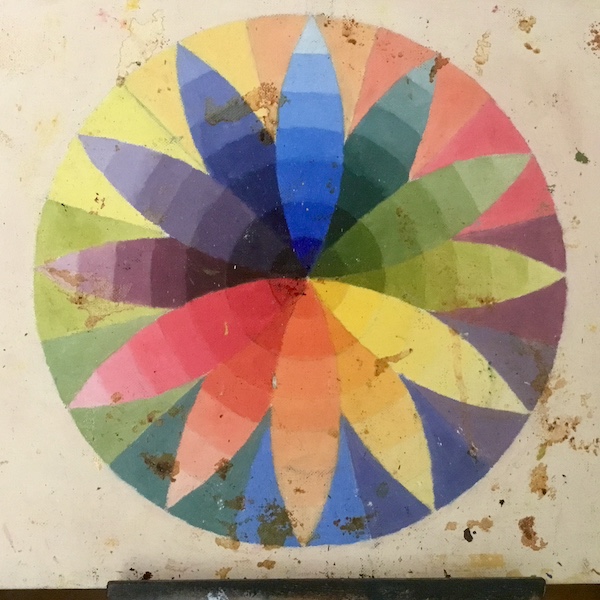
After making a few remarks to the class, Patricia announced that she would tend to a couple of new students, before making her rounds. Then she walked over to me and my table companion, introduced herself, explained the purpose of a color wheel, and told us that our first assignment was to paint one.
This might be getting a little too deep into the weeds, but I will explain some basic principles of color theory. Red, blue, and yellow are the three primary colors. The three secondary colors are orange, purple, and green. Each secondary color is a mixture of two primaries:
- Red + Blue = Purple
- Blue + Yellow = Green
- Yellow + Red = Orange
Each primary color has a secondary color as its complement. You will end up with black, when you mix the complementary colors together. You know you have the right balance of red and blue in your purple, if adding yellow to it results in black. If instead you get a muddy reddish brown, then you used too much red. A murky greenish brown means you have too much blue in your purple. The color wheel doesn’t eliminate trial and error, but it provides a visual guide to help the artist get to the right blend more quickly.
Mixing a primary color with its complement is the best way to mute tones and add shading in a painting. You can mix your color with black to do the same thing, but you will sacrifice a good measure of richness and vibrance from your palette. Perhaps the real benefit of this exercise was that it engaged my eye, my hand, my brain, and my judgment in a way that enhanced my ability to “see.” That color wheel became a fixture in my paintbox, and several years passed before I bought a tube of black paint.
Patricia was a stickler for good work habits. She emphasized how important it was to squeeze the oil paint out from the bottom of the tube, and then to properly fasten the lid. Using an example from her own life, she drove home the point that the paints would last forever, as long as we did that.
“Why, I’ve had some tubes of paint in my Paris studio for more than 20 years!” she exclaimed. “Of course, when your paints sit for so long, the caps get stuck. I keep a sterling silver nutcracker in my paintbox. It works like a charm for unscrewing those stubborn things!”
One morning Patricia was particularly jovial. At the end of her recitation on the proper technique for using copal painting medium to achieve a glossy finish on a painting, she divulged that over the weekend she and her dear friend Walter Cronkite had gone sailing on his yacht.

A couple of weeks later, Patricia finished up a lesson by sharing an embarrassing story about a party she had attended the previous Saturday night. “There was a handsome man standing a few feet away from me. I knew him from somewhere, but I couldn’t place him.” She smiled mischievously. “I concluded he was one of my students, who had been skipping school, so I decided to scold him.
“I walked up to him,” she revealed, “And I said, “Young man, what do you have to say for yourself? I haven’t seen you in class in quite some time.’
“He must have thought I was crazy,” she laughed. “He looked confused. ‘Madame, do you know who I am?’ he asked.
“‘Of course!’ I replied. ‘You’re my student. And a very naughty one.’
“‘No, ma’am,’ he said. ‘I’m Keir Dullea.’”
She chuckled. “I felt ridiculous. But he was such a good sport about the whole thing.”
It was no wonder Keir Dullea had looked familiar. Just a couple of years earlier, he had starred in Stanley Kubrick’s blockbuster hit “2001: A Space Odyssey.” His face would have been plastered on posters throughout midtown Manhattan.

Although Patricia never showed us any of her work, she informed us she was a follower of Tibetan Buddhism, and that all of her paintings depicted meditation wheels or mandalas. Then she told us about the time that she met the Dali Lama. She didn’t say where this occurred, but I assume she traveled to his home in Dharamsala, India, sometime in the 1960’s.
They were about to descend a staircase, when the Dali Lama offered Patricia his arm. “It was the most magical experience of my life,” she sighed. “I placed my hand over his arm, but I don’t think I ever touched him. As we went down the stairs, I had the sensation that I was floating.”
The far-away look on her face evaporated, and the mystical dreamer was once again the self-assured dowager. She walked up behind me as I sat staring at my color wheel, trying to decide if I should add another thin layer of paint.
“It’s done,” she declared, as though she read my mind.
“I wasn’t sure,” I confided. Leaning forward slightly, I gazed into the concentric rings of receding colors, marveling at how just three primary pigments plus white could be combined to create nearly every hue I would need to paint a still life or a portrait or a scene from nature.
“It looks like a mandala,” my teacher observed. “Don’t you agree?”
Discover more from Roxane Gilbert
Subscribe to get the latest posts sent to your email.
 Roxane Gilbert