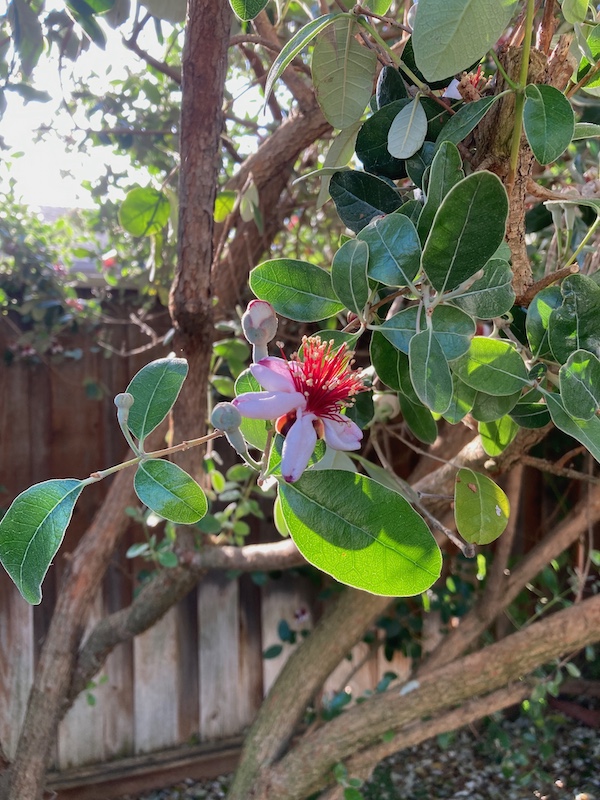
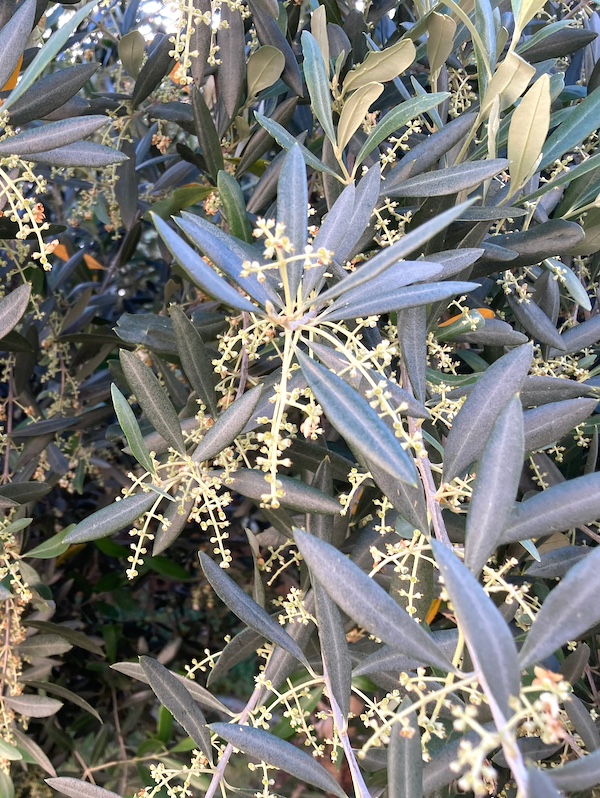
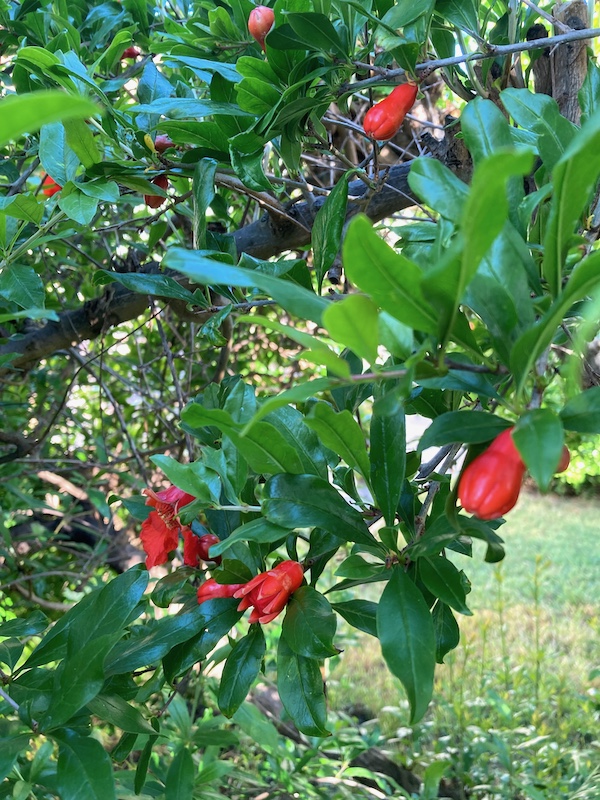
All of the roses in my garden have been in full bloom for at least a couple of weeks, but it was just this morning that I noticed there were several red and white blossoms on the guava tree. The olive tree is loaded with tiny off-white buds, and one of my pomegranates has several bright reddish-orange flowers. It looks like I may have an abundance of guavas, olives, and pomegranates this year. But these fruits are slow to set and ripen, so I won’t really know until mid-to-late fall.
There is no guarantee that my efforts in tilling, planting, pruning, and watering will pay off. Forces of nature, like heavy winds, late rains or hale storms, insects or fungal infections, may adversely affect production. Or if, heaven forbid, the region has horrific fires like in recent years, a blanket of smoke may obscure the sun for months, impeding the fruit from maturing and ripening.
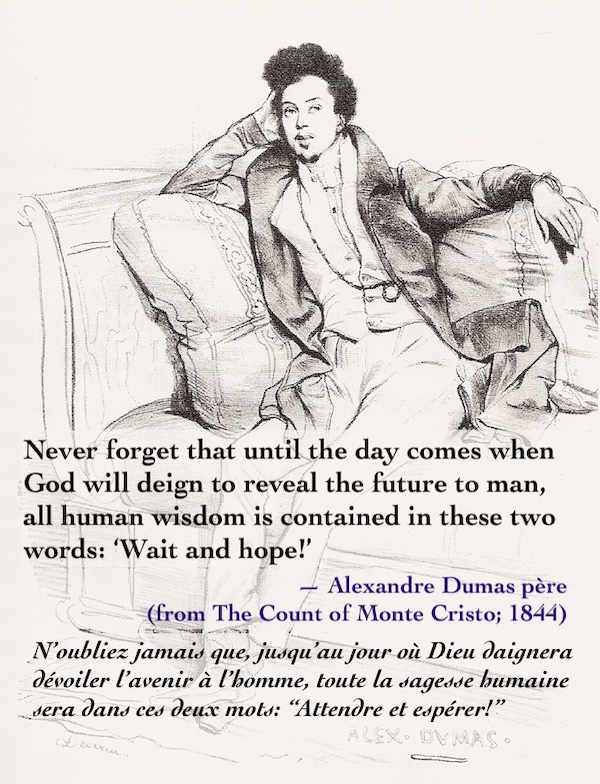
While considering the normal cycles of nature and the many other factors beyond my control, I thought about the ending of The Count of Monte Cristo, by Alexandre Dumas père. In a letter to a young acquaintance, the main character, Edmond Dantès, writes, “All human wisdom is contained in these two words: ‘Wait and Hope.’”
After all of the toil of weeding and feeding is done, it really is waiting and hoping that fills the gap between many of the paired actions inherent to gardening, such as blooming and bearing; sewing and reaping.
The lyrics to a song by Pete Seeger (1919-2014) called Turn! Turn! Turn! (To Everything there is a Season) came to mind. I first heard this song in 1965, when it was recorded by an American folk-rock band called The Byrds. It was a big hit, reaching number one on the Billboard Hot 100 chart by the end of the year. As a fledgling guitar player, I strummed the chords, while my fellow teenaged peaceniks sang along:
[Chorus]:
To everything – turn, turn, turn
There is a season – turn, turn, turn
And a time to every purpose under heaven
—–
A time to be born, a time to die
A time to plant, a time to reap
A time to kill, a time to heal
A time to laugh, a time to weep
[Chorus]
A time to build up, a time to break down
A time to dance, a time to mourn
A time to cast away stones
A time to gather stones together
[Chorus]
A time of love, a time of hate
A time of war, a time of peace
A time you may embrace
A time to refrain from embracing
[Chorus]
A time to gain, a time to lose
A time to rend, a time to sew
A time for love, a time for hate
A time for peace, I swear it’s not too late!
With the exception of a couple of catchy embellishments, mostly in the refrain, the words were lifted from the King James Version of Ecclesiastes 3:1-8:
- To every thing there is a season, and a time to every purpose under the heaven:
- A time to be born, and a time to die; a time to plant, and a time to pluck up that which is planted;
- A time to kill, and a time to heal; a time to break down, and a time to build up;
- A time to weep, and a time to laugh; a time to mourn, and a time to dance;
- A time to cast away stones, and a time to gather stones together; a time to embrace, and a time to refrain from embracing;
- A time to get, and a time to lose; a time to keep, and a time to cast away;
- A time to rend, and a time to sew; a time to keep silence, and a time to speak;
- A time to love, and a time to hate; a time of war, and a time of peace.
Many years passed by before I read Ecclesiastes in its entirety. I was over 50, when a rabbi suggested that it was a good text for a person of a mature age to study. He was right. It is written by an older man, looking back on his experiences. It has a melancholy, almost depressing tone, which might be off-putting to a younger person. Throughout the book, the author, thought to be King Solomon, laments that no matter how much success or wealth or wisdom a man achieves, it is fleeting and is ultimately an exercise in vanity and futility. However, he concludes that life’s simple gifts may be a source of pleasure, and true meaning comes from our relationship with God.
Although Turn! Turn! Turn! derives its description of the cyclical pattern of Nature directly from Ecclesiastes, it ignores any need for a theological anchor. When we look at Edmond Dantès’s agonizing journey from brutalized victim to revenge seeker in The Count of Monte Cristo, we see how perilously close he comes to becoming as evil as his persecutors. Yet at a critical moment, he steps back. His trajectory from despair to hope mirrors King Solomon’s, but his resolve springs from his personal endurance and hard-won moral clarity. If Dantès does not specifically credit the Divine for his redemption, he acknowledges that supreme power and infinite wisdom belong to God alone.
As I enjoy the peace and beauty of my garden, I will wait and hope. Whether or not the trees bear fruit, I am content.
Discover more from Roxane Gilbert
Subscribe to get the latest posts sent to your email.
 Roxane Gilbert