Considering how many times Donald Trump has pointed to the representatives of the press and declared, “Fake news,” there is still a lot of handwringing in some quarters. In the pre-internet world of my childhood, I started reading newspapers regularly when I was about 12-years old. Walter Cronkite, the anchorman on the CBS Evening News, was esteemed as the most trusted man in America. Yet I preferred to watch the Huntley-Brinkley Report on NBC. There was something unsettling about the way David Brinkley recited the daily tally of American and Vietcong soldiers killed and wounded in Vietnam. Some nights, he was almost smirking. Even as a child, I could see that he didn’t believe the official Pentagon figures for a minute.
When Bob Woodward and Carl Bernstein broke the Watergate story in 1972, journalism took on an added aura of nobility. Maybe we could no longer trust our elected officials, but we believed that the investigative journalists at the Washington Post and the New York Times were protecting our republic. A Gallup poll done that year found that 68%-72% of Americans trusted the news media. By 2024, polling showed that trust was down to just 32%. Even worse, 36% of Americans have no faith in the media at all. That probably doesn’t surprise anyone.
When I was still a kid in grade school, a graduate student at Northwestern University introduced me to the premise that “accuracy is not adequacy.” Maybe that’s why I maintain a degree of skepticism, when evaluating the validity of research findings, a history book, a random email, or even the words coming out of someone’s mouth. It has become my habit to scratch beneath the surface and do my own investigation.
The outlook that “accuracy is not adequacy” also serves as a guidepost for judging the news media. While fact-checking serves a purpose, it doesn’t reliably tell us what has been left out. As former Secretary of Defense Donald Rumsfeld famously said, “There are known knowns, things we know that we know; and there are known unknowns, things that we know we don’t know. But there are also unknown unknowns, things we do not know we don’t know.”
Newsrooms operate on a budget and practical concerns influence editorial decisions on what to cover and what to leave out. However, it seems that many journalists also view themselves as valiant guardians of the secrets of selected celebrities, business leaders, politicians, etc. Many of us who are old enough to remember the gusto with which the pit bulls in the press pursued President Nixon over allegations that his campaign spied on his opponents can only draw one conclusion from their indifference to mounting evidence of Biden family corruption. If potential money laundering and influence peddling on behalf of adversarial foreign nationals by the family of a sitting vice president and later president doesn’t warrant a second look, it is not difficult to conclude that the deck is stacked.
We take for granted that a free press is a vital check and balance in our democratic republic. Yet the U.S. Constitution that was approved in Philadelphia in 1787 did not contain this guarantee. Thomas Jefferson was in Paris, serving as the U.S. ambassador to France, at the time of the Constitutional Convention. He wrote to James Madison on December 20, 1787, to give him his analysis of the document. After pointing out its strengths, he went on to say,
“I will now add what I do not like. First the omission of a bill of rights providing clearly and without the aid of sophisms for freedom of religion, freedom of the press, protection against standing armies, restriction against monopolies, the eternal and unremitting force of the habeas corpus laws, and trials by jury in all matters of fact triable by the laws of the land and not by the law of Nations.” [Emphasis added.]
Despite pushing for the Bill of Rights, which specifically mentions the freedom of the press, Thomas Jefferson had little faith in newspapers to be accurate or even factual. Although we might be inclined to wonder why modern trust in the news has fallen off so dramatically since the heyday of the 1970’s, the better question might be to ask ourselves why we ever believed that our news sources were reliably credible?

Don’t get me wrong. For over five years, I was researching the life of a British Army general who died in the late 18th century. Although he was well known in his day, he died young and has passed into obscurity, so learning about him has taken some effort. Newspapers were an excellent resource, and I have read hundreds of articles from the late 1700’s. Based on my experience, I find the news reports to be very helpful for establishing a chronology of international and political events. They are also useful in providing insights into fashion, culture, and crime. But when it comes to facts about something as basic as when or where someone was born or died, or details of troop movements on the European continent, I try to find some other documentation to help me evaluate the truth of it.
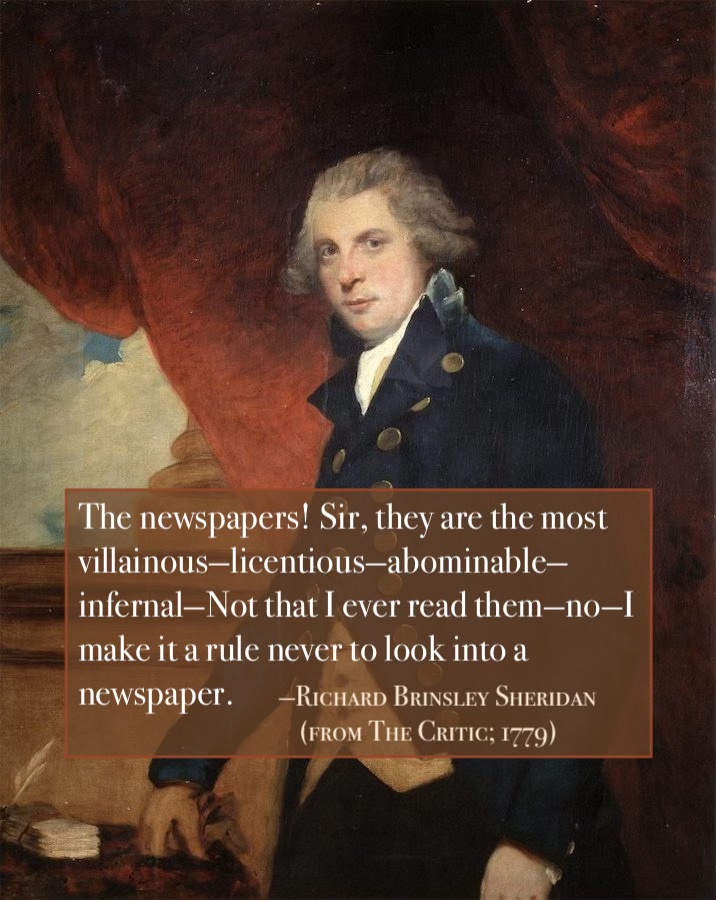
Portrait of Richard Brinsley Sheridan (1751-1816) by Sir Joshua Reynolds (1723-1792)
It didn’t take long to discover that history books or memoirs can be more unreliable than newspapers. You can see from your own lifetime that prominent people are quick to get their version of the story into print. A historian 150 years from now, reading a biography written in the early 21st century about a man like Dick Cheney or Barack Obama would be wise to take it with a grain of salt.
Autobiographies or as-told-to biographies are not new inventions. Any biography of the Duke of Wellington that was published in the early 1800’s, while he was still alive and at the peak of his political power, was most likely written by a sycophant trying to flatter him for personal gain. And since the Duke was an accomplished propagandist, those books are as likely to contain nonsense as fact. Things only got worse in the publishing world as the century progressed. I was appalled to discover numerous examples of newspaper articles and books from the late 1800’s that glibly package speculation, innuendo, and outright falsehoods as known certainties. A writer back in 1890 had to comb through libraries and card catalogues to find reference books. It would have been difficult to verify the resources for accuracy. Picking out some interesting nugget and embellishing it to make it more sensational might attract more readers. Today we can avoid those pitfalls, thanks to the information available to us through the internet. The downside is that a truth seeker has to wade through a minefield of misinformation.
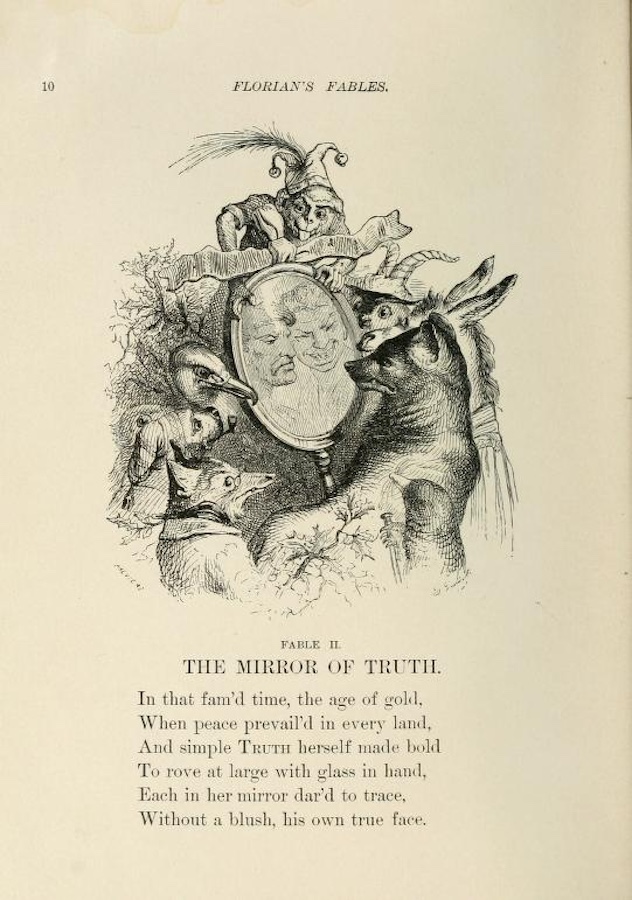
Buried beneath the distortions, falsehoods, and errors, I found enough glimmers of truth to piece together the life story of the British general. The important lesson I learned is that we need to remain skeptical, but trust our instincts and keep digging. The other day, I came across The Mirror of Truth [Le miroir de la vérité], a fable by Jean Pierre Claris de Florian (1755-1794), originally published in 1792. The translation by John Wolcott Phelps (1813–1885), and illustrated by Jean Ignace Isidore Gérard (1803–1847), aka J.J. Grandville, was published in 1888. This fable captures the essence of our struggle.

Discover more from Roxane Gilbert
Subscribe to get the latest posts sent to your email.
 Roxane Gilbert